
Do you have any memorable experiences from your preK-12 math classes? What specifically stands out to you? How did those experiences make you feel? For me, one standout moment was when I memorized my multiplication tables in third grade to go to McDonald’s with my teacher as a reward. My best friend and I planned to pass on the same day to enjoy lunch together. I also recall geometry being quite challenging when I was a freshman. The different shapes and properties were difficult to remember, and I didn’t enjoy it. However, I found Algebra 2 to be enjoyable since I was good at memorizing the rules. Like chess, Algebra is a game where you must “win” by getting the correct answer. I loved that aspect of it.
Historically, students would observe their teacher solving math problems, understand the steps involved, and then attempt to solve the problems independently. They would sit in their seats, facing the front, and take notes or practice the steps quietly on paper. The storylines of students created by these experiences categorized each of them as either “a math person” or “not a math person.”
Early Math Essentials Change Students’ Storylines
The Michigan Early Math Essential Instructional Practices is a document covering PreK through 5th grade and aims to change students’ storylines across Michigan. The document promotes collaborative, exploratory, and creative teaching and learning of math. Students are encouraged to work independently, in partnerships and small groups, and through whole group discussion while moving around the classroom and collecting tools needed to solve problems in ways that work for their thinking. They learn to make sense of math together on a path of increasing complexity while talking to each other, sharing their thinking, problem-solving, and debating or defending their ideas. Making mistakes is encouraged, and students learn from them while celebrating and examining them. They should feel valued and confident in their ability to persevere through challenging tasks and content while smiling, laughing, and contributing.
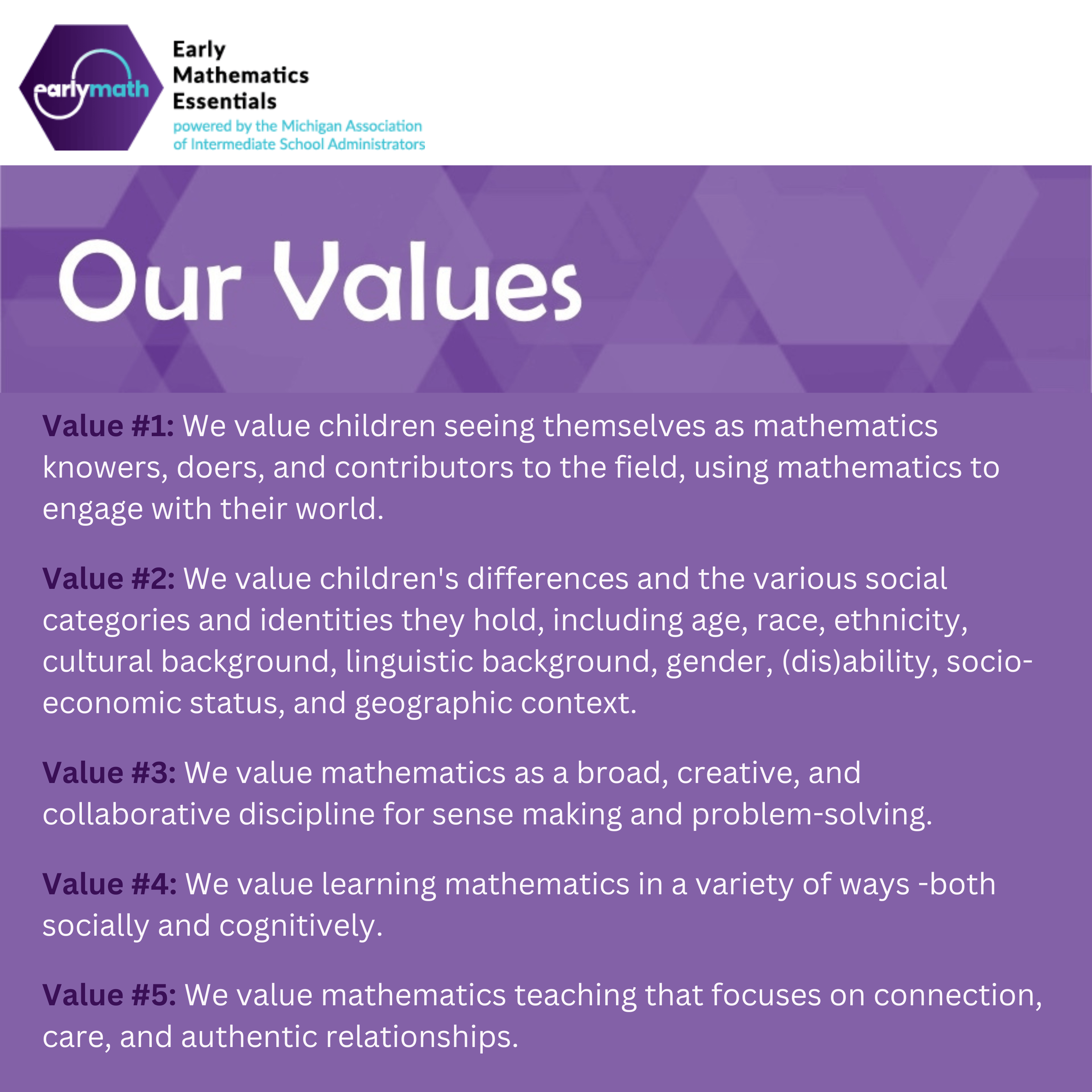
The Early Math Essentials document explains how to reach this vision of math instruction. It hopes and expects students to learn through “play and tinkering” (Essential 1), develop strong mathematical identities (Essential 2), and have an equitable voice in the classroom (Essential 3). The document is grounded in values that respect the diverse experiences of both students and teachers. It encourages them to learn in ways that make sense to them. We encourage you to review these values and consider how to apply them in your classroom. In what ways might these values contribute to reshaping students’ storylines in your classroom and across Michigan?
Kent ISD’s Math Team Leads the Way in Math Education
Michigan’s outlook for math education is promising, and Kent ISD’s Math Team is leading the way. Our Michigan Math Educators Network (MichME) will host K-12 group learning in the mornings, followed by grade-specific breakouts focused on essential standards. We invite teachers, coaches, and administrators to join us. Additionally, the Early Math Task Force is diligently promoting these standards with videos featuring Michigan classrooms on their YouTube channel. For example, we would like to share a delightful video from the Task Force highlighting the valuable work happening statewide.
#EarlyMathEssentials #Innovation #Equity #WeLeadLearning #KentISDpd
This blog post was written by Kelli Vansetters, a Math Consultant for Kent ISD, and edited by Amanda Walma, a Marketing and Communications professional for Teaching and Learning at Kent ISD.
Leave a Reply